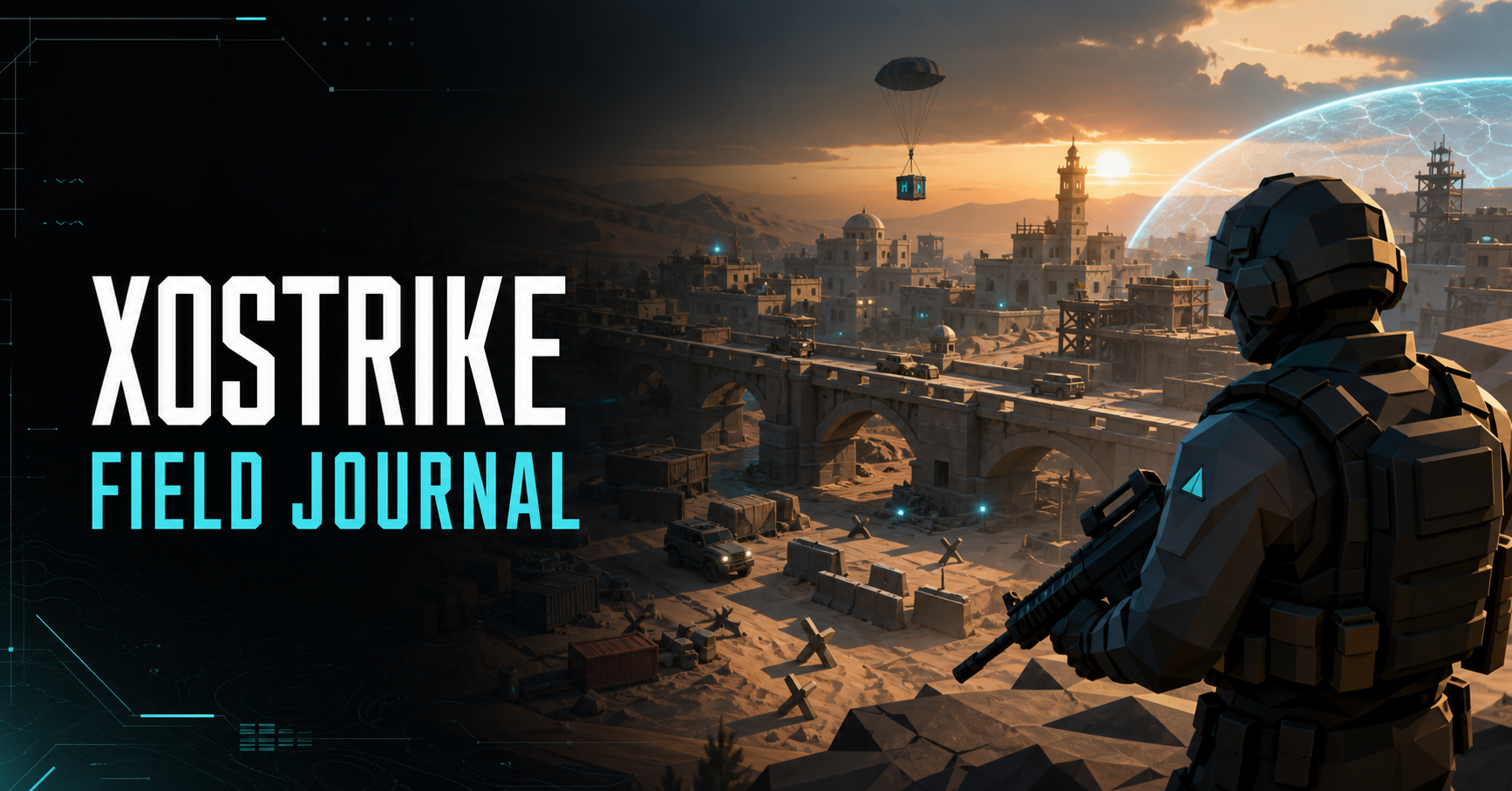
Dust Royale V2 is a 30-player version of X0STRIKE built around one enlarged desert map. The central Dust combat space is surrounded by additional districts, enterable buildings, roads, a large bridge, parked vehicles, barriers and authored loot routes. Before a room starts, the creator chooses either a timed match or a safe-zone match. That choice changes how you should move from the first flight onward.
Choose the room rule first
A timed room lasts 5, 10 or 15 minutes. The full map remains open, there is no damaging circle and eliminations lead to a five-second redeploy. This is the more forgiving rule for learning the map, testing weapons and taking repeated fights. Because opponents can return from the aircraft, a cleared building does not remain safe forever.
A safe-zone room adds a visible current circle and the next destination. The terrain is the same, but the zone creates a deadline. A strong position outside the next circle is temporary; a modest building inside it may be more valuable than a distant loot-rich compound.
| Room rule | Pressure | Best approach |
|---|---|---|
| 5-minute timed | Short scoring window, frequent contact | Land near a dense district, buy quickly after death and keep moving toward sound. |
| 10/15-minute timed | Longer rotations and more redeploys | Learn repeatable loot routes, contest airdrops and change angles after every elimination. |
| Safe zone | Position shrinks over time | Read both circles early, rotate before roads become exposed and preserve a vehicle for the late move. |
Build a landing route, not a landing point
The aircraft gives you a broad view of the enlarged map. Do not select a roof only because it is directly below the flight path. Select a short sequence: first weapon, matching ammunition, armor, then a defensible exit. Enterable houses are useful because their doors and rooms break long sightlines, but a doorway can also funnel you into an opponent.
During freefall, look for three things: nearby parachutes, a second building within a short sprint and a road or bridge route that does not force you across open ground. If another squad lands on the same cluster, take the first usable firearm rather than searching for a perfect loadout. Ammunition returns to authored spots, and field weapons later respawn as a fresh random roll, so a district can become useful again in a long match.
Use the five-second redeploy market
After an elimination, the redeploy countdown lasts five seconds. Press B during that window to open the aircraft market. The market contains the same firearm catalog used by the other combat modes, and the selected weapon arrives with ammunition. Confirm the weapon before the timer expires; changing the selection refunds the previous choice so you are not locked into a mistaken click.
A redeploy should solve the problem that caused the previous death. If a distant marksman controlled the road, choose a weapon and landing lane that lets you close through buildings. If a close-range player held a stairwell, land on an adjacent roof or use a different doorway. Returning to the exact same angle with the exact same plan simply gives the defender another predictable target.
Drive with a destination
Press E near a usable car to enter it. W accelerates, S reverses, A turns left and D turns right. Cars are rotation tools, not permanent armor. Sustained gunfire damages a vehicle; heavy damage can ignite it, and an explosion can kill the driver. Leave a burning vehicle before the final detonation and avoid parking the damaged chassis against the only safe doorway.
Vehicles are strongest for crossing long roads, moving from an outer district to the central fight and beating a safe-zone rotation. They are weakest inside tight alleys, where barriers restrict steering and opponents can predict the exit animation. Slow down before entering dense housing and leave enough space to get out on the protected side.
Treat every airdrop as a public signal
An airdrop falls every minute. It can provide level-three helmet and vest equipment, but the descending crate also tells every nearby player where contact is likely to happen. Watch the surrounding roofs, bridge approaches and vehicle routes before touching the crate. In a squad, one operator can inspect the drop while the others hold different sightlines.
In timed rooms, an airdrop is often worth contesting because death is temporary. In a safe-zone room, the circle has priority. A level-three vest is not valuable if the crate leaves you outside the next zone with no route back.
A repeatable match plan
- Before launch: read the room rule and time limit. Decide whether you are optimizing for repeated fights or survival through rotations.
- From the aircraft: identify one main district and one fallback. Count nearby parachutes.
- On the ground: complete a functional kit before chasing distant shots.
- At one minute: expect the first airdrop and reposition before its approach becomes crowded.
- After a death: use the market intentionally, choose a new lane and do not dive onto the same held angle.
- With a car: select the exit point before accelerating. Abandon the vehicle if it begins burning.
The fastest way to learn Dust Royale V2 is a five-minute timed room: it exposes the complete map, keeps downtime low and lets you repeat landings. Once the districts and bridge routes feel familiar, safe-zone rooms turn that knowledge into positioning decisions.
Open the X0STRIKE lobby to create a room, or continue with the complete controls and first-match guide.